
Anchor Bolts in Oil, Gas, and Petrochemical Facilities
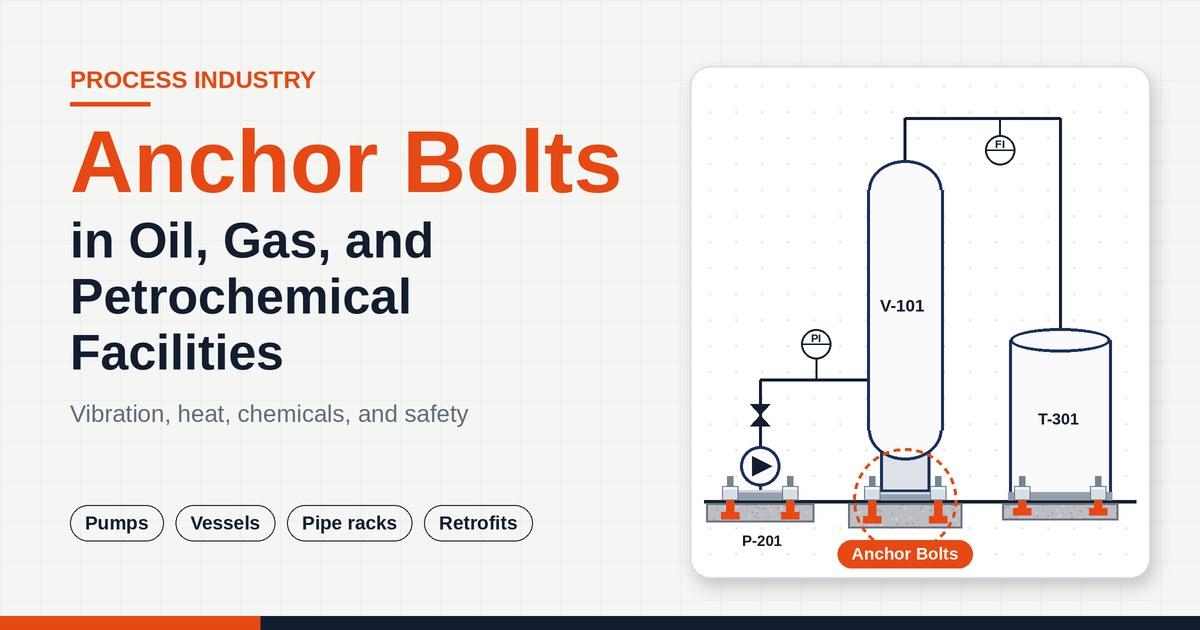
A refinery or gas plant is a crowded place: towers, tanks, compressors, pipe racks, and heat exchangers, all held to the ground by Anchor Bolts. The loads are heavy, the equipment vibrates, the surroundings are corrosive, and a failure can mean a shutdown, a leak, or worse. That raises the standard for every rod that goes into a foundation. This guide explains where Anchor Bolts matter most in process facilities, what makes these sites demanding, and how to specify, install, and inspect them well.
Why Process Plants Are Demanding
Compared with an ordinary building, a petrochemical site adds several pressures at once:
- Heavy, concentrated loads from vessels, columns, and rotating machinery
- Vibration and repeated loads from pumps, compressors, and turbines
- Thermal movement from hot lines, exchangers, and furnaces
- Corrosive exposure to chlorides, chemicals, and washdown water
- Fire and explosion scenarios that designers must consider
- Live operations, where work happens near energized equipment and pressurized lines
- Long service life, often several decades, with shutdowns as the only chance for major work
Every one of these changes how Anchor Bolts should be chosen and looked after.
Where Anchor Bolts Are Used
| Asset | Main demands | What the Anchor Bolts do |
|---|---|---|
| Pumps, compressors, turbines | Vibration, alignment, repeated loads | Hold equipment baseplates tight and aligned |
| Vertical vessels and columns | Overturning from wind and seismic action | Resist uplift and shear at the skirt or base ring |
| Storage tanks | Uplift, sliding, seismic effects | Tie shells or anchor chairs to the foundation where required |
| Heat exchangers | Thermal expansion, piping loads | Fix one support, allow the other to slide |
| Pipe racks and structural steel | Wind uplift, thermal forces, impact | Connect column bases to piers |
| Flare stacks and tall structures | Large overturning moments | Carry heavy, repeated loads into the foundation |
| Skids and modular units | Transport and operating loads | Secure frames to slabs or piers |
Rotating Equipment: Vibration, Grout, and Alignment
Machines that rotate, such as compressors, pumps, and turbines, depend on their foundations staying stable. A baseplate that shifts a few millimeters can strain couplings, pipes, and bearings. Several habits protect against this:
- Choose the right grout. Epoxy grout is common under vibrating equipment, and the project specification controls the product, thickness, and curing.
- Specify pretension and locking details. Properly tightened rods keep the joint clamped, and locking nuts or double nuts help where vibration could loosen the connection.
- Use sleeved anchors where specified. The free length lets the rod stretch evenly under preload.
- Recheck after startup. Settlement and grout creep can reduce clamping force.
- Follow the standards. API RP 686 covers machinery installation, and ACI 351.3R gives guidance for dynamic equipment foundations.
Fatigue is a concern too. Repeated loading can start cracks at thread roots, so thread quality and preload matter more than they do for static structures.
Vessels, Columns, and Tanks: Overturning and Uplift
Tall vertical vessels and columns catch wind and respond to earthquakes. That tries to tip them, so Anchor Bolts on one side go into tension while the opposite side presses down. An empty or lightly loaded vessel in a strong wind is often the governing case, not the operating one.
Details matter here:
- Anchor chairs and base rings spread the load into the shell and into the concrete
- Anchor bolt circles must match the vessel drawing exactly, so check the vendor’s layout against the foundation drawings before the pour
- Hold-down capacity has to cover the concrete as well as the steel, since breakout often governs in a pedestal
- Tank standards, such as API 650 for welded storage tanks, set requirements for anchorage when uplift or overturning must be resisted
Pipe Racks, Supports, and Thermal Loads
Pipe racks look light, but they carry long runs of hot and cold pipe. Pipes expand and contract, and anchor points on the line push force into the supports. The base connections feel that force, along with wind uplift and occasional impact.
Designers separate fixed points from sliding supports, and the anchor details follow. Slotted holes, sleeves, and slide plates let expected movement happen without overloading the rods. If a plate cannot move when it is supposed to, the Anchor Bolts end up carrying forces nobody planned for.
Heat, Fire, and Blast
High temperatures and extreme events need their own thought.
Heat. Elevated temperatures reduce steel strength and can affect concrete and adhesives near hot equipment. Check the temperature rating of any adhesive anchor, and use insulation, shields, or different materials where heat is a concern.
Fire. Many facilities apply passive fire protection to steel supports and column bases. Designers consider how fire affects the anchors and the concrete around them, because adhesive anchors in particular can lose strength at high temperatures.
Blast. Some sites include blast-resistant buildings and equipment supports designed for sudden, high-rate loads. Those anchors need project-specific design and should not be treated like standard connections.
Corrosion and Chemical Exposure
Process plants combine salt air, process chemicals, washdown water, and leaks. Water collects where each rod leaves the concrete, and corrosion often starts there, hidden beneath the base plate.
Common protections include:
- Hot-dip galvanizing for many outdoor installations
- Stainless steel for aggressive chemical or marine conditions, with attention to mixing metals in damp areas
- Chemical-resistant epoxy grouts and sealants around the base
- Containment curbs and good drainage, so spills and washdown water do not pool at the plate
- Protective caps and coatings that suit the actual chemicals present
Very high-strength steels need extra care around galvanizing and hydrogen embrittlement, so the engineer should decide those details.
Materials and Traceability
For cast-in rods, ASTM F1554 is widely specified, and Grade 55 and Grade 105 are common choices depending on load. Process facilities often also use alloy bolting such as ASTM A193 Grade B7 with matching heavy hex nuts to ASTM A194 Grade 2H, particularly where higher temperature or higher strength is required.
Traceability is a priority in this industry:
- Mill test certificates that match heat numbers on the bolts, commonly to EN 10204 type 3.1 or better
- Grade markings checked on delivery
- Positive material identification (PMI) where the owner requires it, to confirm the alloy on site
- Coating reports for galvanized or coated rods
- Matched nuts and washers, ordered as a set with the rods
Suppliers differ in what they make, test, and document, so compare them on certification and traceability as well as price. A buyer in the Gulf region, where many oil, gas, and petrochemical plants operate, might add Petrofast Middle East FZC, an Abu Dhabi-based manufacturer whose catalog lists stud anchors, to a shortlist and then request those documents. Whoever you choose, reject any delivery of Anchor Bolts that does not match its paperwork, and send substitutions to the engineer for written approval.
Installing Anchor Bolts in New and Operating Plants
New foundations follow the usual discipline: a rigid template, surveys before and after the pour, protected threads, and verified projection. Brownfield work, where new equipment goes into an operating plant, adds more steps:
- Obtain the proper permits for excavation, drilling, and hot work, and follow isolation and lockout rules
- Locate buried utilities, conduits, and reinforcement before drilling, using drawings and scanning
- Use post-installed anchors qualified for the concrete condition, the loads, the temperature, and any seismic requirements
- Follow the manufacturer’s procedure exactly, including hole cleaning for adhesive anchors, since leftover dust is a well-known cause of weak results
- Record everything, including positions, installation data, and tightening, and keep it with the equipment file
Never bend, heat, or weld rods to fit a misaligned plate without written approval from the engineer.
Inspection, Turnarounds, and Management of Change
Plants get few chances for major work, so inspection and planning matter:
- Include base connections in routine walkdowns, looking for rust, loose nuts, cracked grout, and plate movement
- Use scheduled shutdowns to inspect and repair, rather than waiting for failure
- Recheck tightening on vibrating equipment
- Review the Anchor Bolts whenever equipment, loads, or piping change, as part of management of change
- Keep records so future teams know what was installed and why
Quick Checklist
- Loads defined, including uplift, thermal, vibration, and fire cases
- Vendor drawings matched to foundation layouts
- Grout type specified for the duty
- Pretension, locking devices, or sleeves specified where needed
- Coating and materials suited to chemicals and climate
- Certificates, markings, and PMI verified on delivery
- Brownfield permits, scans, and procedures followed
- Inspection and turnaround plan in place
Conclusion: Anchor Bolts Keep Process Plants Steady
In oil, gas, and petrochemical facilities, Anchor Bolts connect heavy, hot, vibrating, and sometimes dangerous equipment to the ground. They work best when the loads are understood, the materials are verified, the grout and tightening suit the duty, and the connection is inspected throughout its life. Treat them as engineered components, and they will do their quiet work for decades. Final design, specification, and acceptance always belong with the engineer of record, the owner’s standards, and the governing codes.

 Polish
 Arabic
 French
 Spanish
 Portuguese
 Deutsch
 Turkish
 Dutch
 Italiano
 Russian
 Romaian
 Portuguese (Brazil)
 Greek