
Scheduled Logistics Delivery Services: Why Delivery Windows Matter More Than Speed
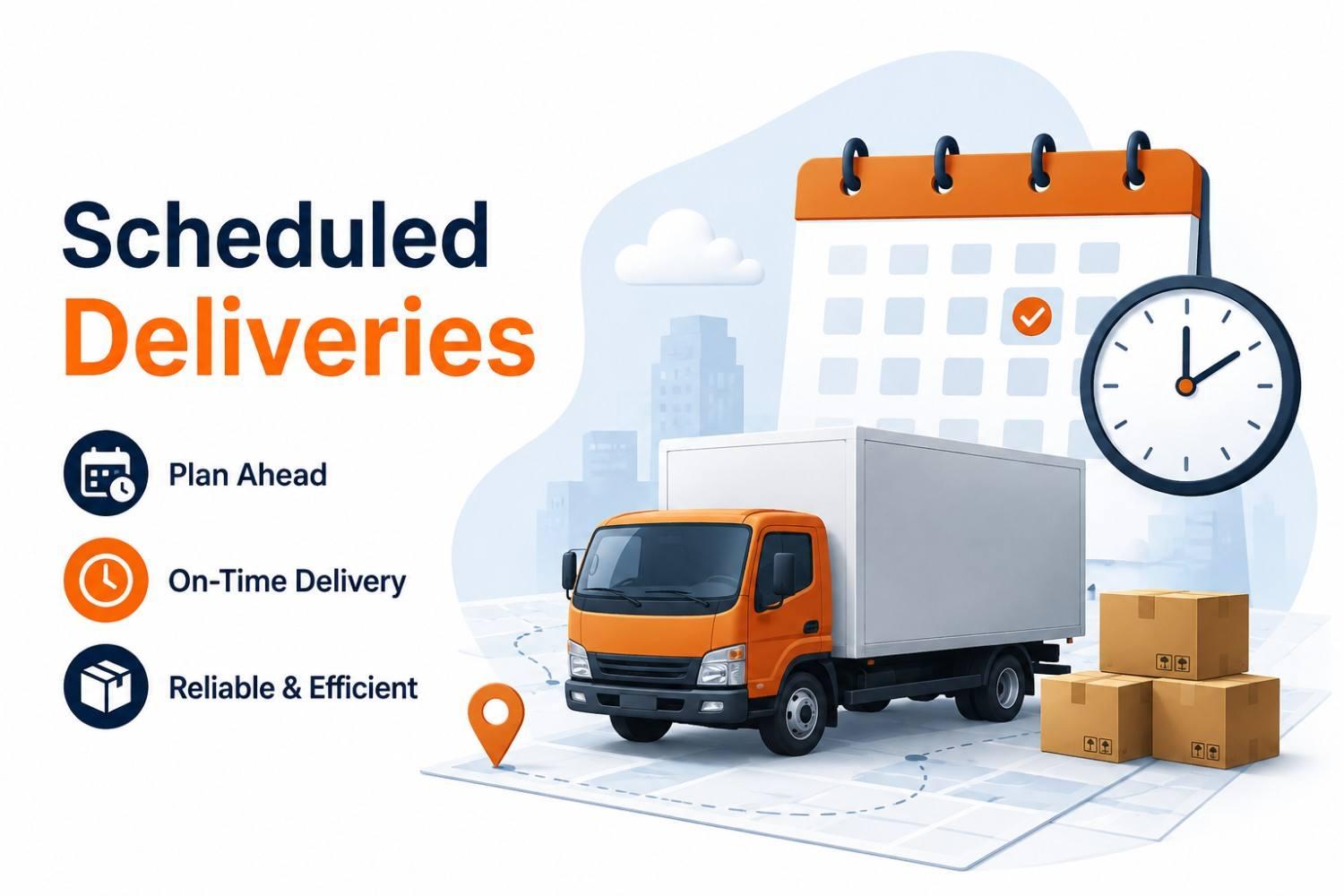
A delivery arriving early can create almost as much trouble as one arriving late.
That sounds strange until you look at how businesses actually receive goods. A warehouse may have limited unloading capacity. A retail store may accept supplier vehicles only during fixed hours. A manufacturing unit may have labour and equipment arranged for a particular receiving slot. In these situations, scheduled logistics delivery services are not simply about transporting a shipment from one place to another. They are about making the arrival fit the operation at the other end.
This distinction is becoming increasingly important for logistics teams. Customers do not always need the fastest possible delivery. They often need the delivery to happen at the right place, on the right day, within an agreed time window.
That sounds simple. Managing it consistently is not.
Why Scheduled Delivery Is Becoming a Practical Logistics Requirement
Traditional logistics often measures performance through transit time. If a shipment travelled quickly, the movement is considered successful.
But the receiving side has its own timetable.
Imagine a distributor expecting several consignments during the week. If all vehicles arrive together, the warehouse may not have enough staff to unload them. Vehicles wait, drivers lose productive hours, and the delivery that looks successful on the tracking screen becomes an operational bottleneck.
The same issue appears in retail. A store may have limited backroom space and specific receiving hours. Sending a vehicle whenever it happens to reach the location creates unnecessary friction. A delivery arriving outside the agreed window may have to wait or return.
This is where most businesses struggle. They optimize the movement of the shipment but forget to optimize the arrival event.
A scheduled model starts with the receiving requirement and works backwards. When does the customer want the goods? How long does unloading normally take? Is an appointment required? What happens if the vehicle is delayed? These questions influence the transportation plan before the truck even leaves.
How Scheduled Logistics Delivery Services Work in Real Operations
The basic idea is straightforward: instead of treating delivery as “arrive whenever the route permits,” the shipment is planned around an agreed delivery date or time window.
That requires more coordination than simply assigning a vehicle.
The logistics team first needs information about the order, destination, cargo readiness, and receiving restrictions. The pickup schedule is then aligned with the expected transit time, route conditions, and delivery appointment.
If the shipment is going to a warehouse with limited unloading capacity, for example, the transport plan should allow enough time for the vehicle to reach the facility within the agreed window. The receiving team can then prepare labour, dock space, equipment, or storage capacity.
In practice, this can reduce a surprisingly common source of waste: waiting.
A vehicle standing outside a warehouse for several hours is not just a minor inconvenience. It affects vehicle utilisation, driver productivity, route planning, and sometimes the next customer's delivery.
Good scheduling therefore improves more than punctuality. It can influence the economics of the entire route.
Shipment Scheduling Services in India Need to Account for the Ground Reality
Planning a delivery window on a spreadsheet is easy. Delivering against that window on an actual Indian road network requires a different level of thinking.
Traffic conditions, city entry restrictions, weather, route diversions, loading delays, toll queues, and vehicle availability can all affect the planned arrival time. A schedule that leaves no operational buffer may look efficient but become unreliable in practice.
This is why shipment scheduling services in India need to be built around realistic transit assumptions.
There is also a difference between scheduled and fixed-time delivery. A business may say, “Deliver on Tuesday,” which provides flexibility. Another may require the vehicle between 2 PM and 4 PM because its receiving team is available only during those hours.
The narrower the window, the more carefully the movement needs to be planned.
Logistics teams should therefore avoid promising extremely tight delivery slots unless the network can genuinely support them. A realistic two-hour window that is consistently achieved is often more useful than a one-hour promise that regularly gets missed.
Scheduled Delivery Versus Fast Delivery: Which One Actually Matters?
Speed still matters, but it should not be confused with service quality.
Suppose a shipment reaches a destination one day earlier than expected but cannot be unloaded until the following morning. Has faster transportation created any meaningful value?
Not necessarily.
For many B2B shipments, the more useful outcome is predictability. A receiving warehouse can plan labour when it knows when the vehicle will arrive. A retailer can organise store staff. A production unit can align material receipt with its manufacturing schedule.
This is why scheduled delivery can be more valuable than simply reducing transit time.
Fast delivery is particularly useful when demand is urgent or inventory is running short. Scheduled delivery works differently. It creates coordination between the sender, transporter, and receiver.
The two approaches are not competitors in every situation. In a well-designed logistics network, urgent shipments and appointment-based shipments can coexist, with each being handled according to its actual requirement.
Why Appointment-Based Delivery Can Reduce Hidden Logistics Costs
One of the less obvious benefits of scheduled transportation is better use of resources.
Consider a route with six deliveries. If the first two customers keep the vehicle waiting because their receiving teams are unavailable, the delay can affect every stop that follows.
Now consider the same route with agreed delivery windows. The transport planner has a clearer sequence, while customers know when to prepare for receipt.
Of course, appointments do not eliminate delays. They simply create a reference point against which the operation can be managed.
This is particularly relevant for businesses dealing with large retail chains, organised distribution centres, industrial facilities, and locations where vehicle entry or unloading is controlled.
The economics can also improve when waiting time falls. Better vehicle utilisation means the same transport capacity can potentially handle more planned work without immediately adding another vehicle.
That is a practical benefit, not a marketing claim.
What to Look for in a Logistics Company for Scheduled Deliveries
Choosing a logistics company for scheduled deliveries should involve more than asking whether it offers time-slot delivery.
The important question is how the provider manages exceptions.
What happens when the cargo is not ready at pickup? What happens if the receiving facility changes the appointment? How is a delay communicated? Can the delivery slot be rescheduled without losing control of the shipment?
These details reveal the maturity of the operation.
Technology helps here. Shipment tracking, digital proof of delivery, automated alerts, route planning systems, and customer communication tools can make scheduled transportation easier to monitor.
But technology is only part of the process. A dashboard can show that a vehicle is delayed. The operations team still has to decide whether the customer should be notified, whether the route should be adjusted, or whether the delivery appointment needs to be changed.
Honestly speaking, that human decision-making layer is still important.
When Affordable Scheduled Shipment Services Make Sense
Businesses sometimes assume scheduled delivery will automatically cost more because it requires additional coordination.
That is not always the case.
If scheduling reduces vehicle waiting, failed delivery attempts, route disruption, or repeated customer follow-ups, the overall cost of the movement can improve even if the transportation arrangement requires more planning.
The important thing is to calculate the complete operating cost rather than comparing only the quoted freight rate.
For a business considering affordable scheduled shipment services, I would examine:
-
Delivery failure and waiting history
-
Average unloading time at major destinations
-
Frequency of recurring routes
-
Cost of urgent or rescheduled shipments
-
Vehicle utilisation and route productivity
-
Customer receiving restrictions
This gives a more realistic picture of whether scheduled logistics can create measurable operational value.
Building a Delivery Schedule That Operations Can Actually Maintain
The best schedule is not the one with the smallest possible time window. It is the one the network can maintain repeatedly.
Start with the receiving locations that create the most operational difficulty. Identify their working hours, appointment requirements, unloading capacity, and historical delay patterns.
Then work backwards from the delivery requirement.
If a customer needs the shipment on Wednesday morning, the transport plan should account for cargo readiness, pickup time, loading duration, expected transit, route risk, and an appropriate buffer.
This may sound obvious, but many delivery problems begin because one of these stages is assumed rather than measured.
A logistics team should also review performance after implementation. If a particular route repeatedly misses its scheduled window, changing the promised time may be more sensible than repeatedly blaming the transport operation.
Scheduling should evolve from actual performance data.
The Role of Scheduled and Timely Delivery by Appointment in 2026
In 2026, logistics visibility is becoming increasingly connected with operational planning. Businesses are not only asking where their shipment is. They want to know whether it will reach the destination when the receiving operation is ready for it.
That difference matters.
More integrated transportation systems can connect order information, vehicle status, route conditions, warehouse requirements, and delivery appointments. Predictive tools can also help identify potential delays before they become missed delivery windows.
But the future of scheduled logistics is unlikely to be completely automated.
There will still be unusual traffic conditions, unexpected loading delays, customer changes, vehicle issues, and shipments that do not follow the original plan. The stronger logistics operation will be the one that can recognise these exceptions early and adjust the schedule without losing visibility.
The focus is therefore shifting from simply tracking transportation to managing the reliability of the delivery commitment.
Conclusion
Businesses should not introduce appointment-based delivery across every shipment simply because it sounds more organised.
Start with the lanes and customers where timing actually affects operations. Retail replenishment, warehouse deliveries, recurring B2B shipments, and locations with restricted receiving hours are obvious areas to examine.
Measure what happens before and after scheduling. Look at waiting time, failed deliveries, vehicle utilisation, delivery-window compliance, and customer complaints.
If those indicators improve, expand the model gradually.
The real purpose of scheduled logistics delivery services is not to make logistics look more sophisticated. It is to remove uncertainty from a part of the supply chain where uncertainty creates unnecessary cost.
A shipment is not truly delivered successfully just because it reached the destination.
It is successful when the goods arrive when the receiving operation is ready to handle them.
FAQs
1. What are scheduled logistics delivery services?
Ans. These services organise transportation around an agreed delivery date or time window instead of relying only on standard transit estimates. They are useful when the receiving location has specific operating or unloading requirements.
2. Is scheduled delivery better than fast delivery?
Ans. It depends on the shipment. Urgent orders may require speed, while regular B2B or retail deliveries often benefit more from predictable arrival times that match receiving schedules.
3. What is appointment-based delivery in logistics?
Ans. Appointment-based delivery means the receiver and logistics provider agree on a delivery slot before the vehicle arrives. It is commonly useful where warehouse capacity, store hours, or unloading arrangements are restricted.
4. Can scheduled shipment services reduce logistics costs?
Ans. They can help reduce costs associated with vehicle waiting, failed delivery attempts, unnecessary rescheduling, and inefficient route planning. The actual result depends on the shipment pattern and receiving network.
5. Who needs scheduled logistics delivery services?
Ans. Businesses supplying retailers, warehouses, distributors, industrial facilities, and other locations with fixed receiving windows can benefit from scheduled transportation when delivery timing directly affects their operations.

 Polish
 English
 Arabic
 Spanish
 Portuguese
 Deutsch
 Turkish
 Dutch
Dutch
 Italiano
 Russian
 Romaian
 Portuguese (Brazil)
 Greek
Greek