
How Better Cabling Prevents Costly Business Network Issues
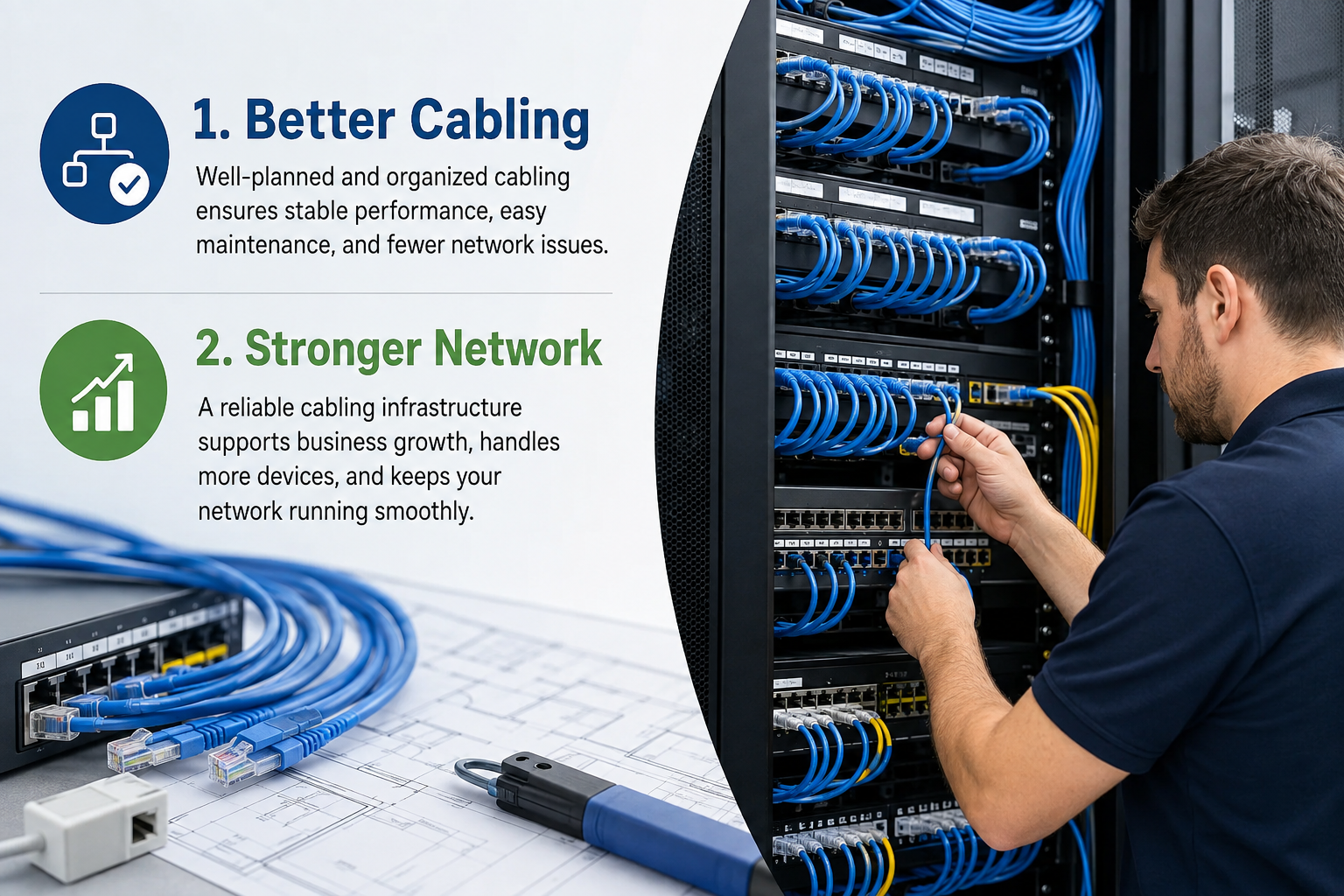
Why Business Network Problems Often Start With Cabling
When a business experiences slow connections, dropped calls, unstable Wi-Fi, or devices that frequently disconnect, the first assumption is often that the problem is the internet service or network equipment. However, the physical cabling infrastructure can also be responsible.
Cables form the foundation that connects computers, phones, wireless access points, security cameras, servers, switches, and other network devices. If the infrastructure is poorly planned, incorrectly terminated, difficult to identify, or damaged during installation, even modern networking equipment may not perform as expected.
A well-designed cabling system creates an organized physical foundation that can support current technology while making future upgrades easier. Proper planning also helps reduce unnecessary rewiring when a business adds employees, devices, workspaces, or new technology.
Common Cabling Problems That Affect Businesses
Many network issues can be traced to physical infrastructure problems. Recognizing these problems early can prevent repeated troubleshooting and unnecessary expenses.
Unlabeled Network Connections
Imagine an employee reports that a network port is not working. If dozens or hundreds of cables look identical and nothing is labeled, identifying the correct connection can take considerable time.
Clear labeling makes troubleshooting much easier. Network ports, patch panels, cables, and other connections should have consistent identifiers that correspond with the network documentation.
Poor Cable Routing
Cables should have planned pathways rather than being randomly bundled through ceilings, walls, or equipment areas. Poor routing can make maintenance difficult and increase the possibility of accidental damage.
Cable pathways should also account for accessibility and future expansion. A pathway that is completely filled during the initial installation may leave little room for additional connections later.
Improper Termination
A cable can appear physically connected while still causing performance problems if the termination is incorrect. Poor terminations may result in intermittent connectivity, packet errors, or inconsistent network performance.
For this reason, installation quality matters just as much as selecting the appropriate cable type.
Choosing the Right Cable for the Environment
Not every business needs the same cabling solution. The appropriate choice depends on network speed requirements, cable distance, device density, building layout, and future expansion plans.
Cat6 is commonly considered for standard business connections, while Cat6A can be appropriate where greater performance capacity is required. Fiber optic cabling is often useful for backbone connections, longer distances, inter-building links, or environments where high bandwidth and electrical isolation are important.
The goal should not be to choose the most expensive option automatically. Instead, businesses should select infrastructure that matches their current requirements while allowing reasonable room for growth.
Why Planning Matters Before Installation
One of the biggest mistakes businesses make is treating cabling as an afterthought.
Before installation begins, the network layout should be reviewed carefully. Important considerations include:
- Number and location of workstations
- Wireless access point locations
- Security camera requirements
- Server and equipment room locations
- Internet service entry point
- Switch and patch panel placement
- Current and expected device count
- Potential office expansion
- Cable pathways and accessibility
A site survey can identify physical obstacles, existing pathways, equipment locations, and areas that may require additional planning. Addressing these issues before installation is generally easier than correcting them after walls, ceilings, and workspaces are complete.
How Commercial Network Cabling Supports Growth
Business technology changes quickly. A company that starts with a few employees may eventually add more computers, phones, printers, access points, cameras, conference room equipment, and cloud-connected devices.
This makes scalability an important part of network infrastructure planning.
Commercial network cabling should provide enough capacity and organization to accommodate reasonable future changes. Extra pathway capacity, organized patch panels, accessible network rooms, and proper documentation can make future additions much simpler.
Instead of rebuilding the physical network whenever the company grows, a scalable infrastructure can provide a more practical foundation for expansion.
The Importance of Cable Management
Cable management is not simply about making a network room look clean. It can directly affect maintenance and troubleshooting.
A properly organized rack makes it easier for technicians to identify connections, replace equipment, trace cables, and perform upgrades. Excessive cable congestion can make routine work more difficult and increase the chance of disturbing unrelated connections.
Patch panels, cable managers, racks, labels, and appropriate pathways all contribute to a more serviceable installation.
Testing Should Be Part of the Process
Installation should not end when every cable has been connected.
Testing helps verify whether individual connections meet the required performance expectations. Depending on the project, testing may identify problems involving continuity, termination, signal performance, or other characteristics.
Certification and documentation provide useful records that can help businesses and IT teams understand the condition of their physical network infrastructure. Professional installation guidance commonly recommends testing, labeling, and documenting the completed system rather than simply assuming that every connection works correctly.
When Should a Business Upgrade Its Cabling?
There is no single upgrade schedule that applies to every organization. However, several situations may indicate that an evaluation is worthwhile.
Consider reviewing the cabling infrastructure when:
- Network problems occur repeatedly
- The office is expanding
- New network equipment is being deployed
- Wireless access points are being added
- Security cameras are being installed
- Existing cables are poorly labeled
- Network racks have become difficult to manage
- The business is moving to a larger facility
- Older infrastructure cannot support current requirements
- Troubleshooting physical connections takes excessive time
An evaluation can help determine whether the problem requires a complete replacement, selective upgrades, improved organization, or simply repairs to specific connections.
How to Avoid Expensive Cabling Mistakes
Businesses can reduce future problems by approaching infrastructure as a long-term investment rather than a short-term installation.
Start with a site assessment, create a detailed cable plan, select suitable media, establish clear pathways, and use consistent labeling. Keep data cabling organized and protect it from unnecessary physical stress. Once installation is complete, test the connections and maintain accurate documentation.
These practices make the network easier to understand and maintain as the business changes.
Final Thoughts
Reliable connectivity begins with more than fast internet and modern switches. The physical infrastructure connecting those technologies also needs thoughtful planning, quality installation, organization, and testing.
Whether a company is opening a new office, renovating an existing workplace, or experiencing recurring network problems, reviewing its cabling infrastructure can uncover issues that are otherwise difficult to diagnose.
A properly planned network cabling system can improve reliability, simplify troubleshooting, support business expansion, and provide a stronger foundation for future technology. By addressing physical infrastructure before problems become expensive disruptions, businesses can create a network environment that is easier to manage today and better prepared for tomorrow.


 Polish
 English
 Arabic
 French
 Spanish
 Portuguese
 Deutsch
 Turkish
 Dutch
Dutch
 Italiano
 Romaian
 Portuguese (Brazil)
 Greek
Greek