
When Should Small Businesses Choose Co-Managed IT Services?
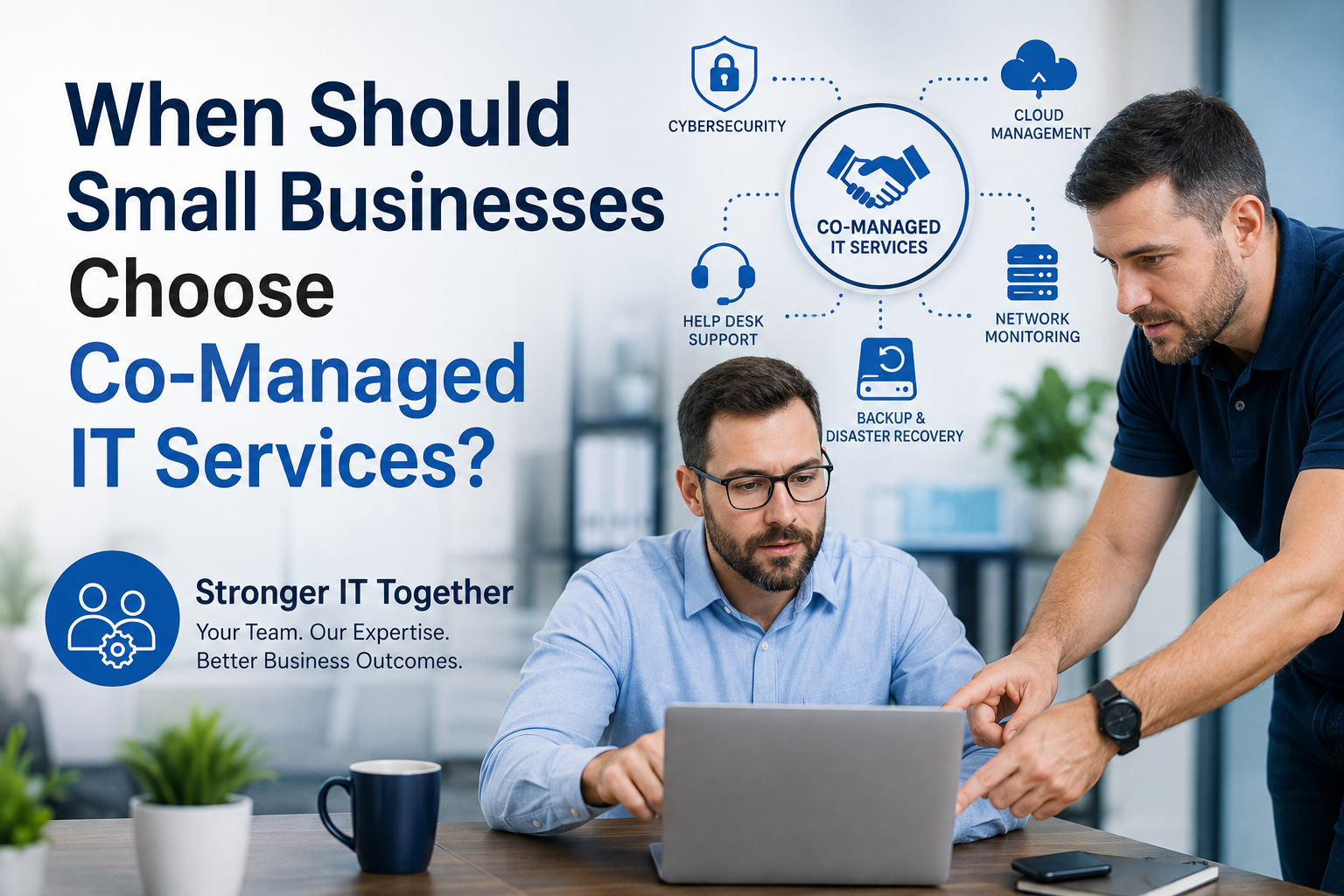
Small businesses often reach a point where their technology needs become too complicated for one employee or a small internal IT team to handle alone. Software updates, cybersecurity, cloud applications, employee support, backups, network problems, and compliance requirements can quickly consume valuable time. At the same time, hiring a large internal technology department may not fit the company's budget.
This is where a hybrid IT support model can provide a practical solution.
Co-managed IT services allow an internal IT employee or department to work alongside an external technology provider. Instead of replacing the existing team, outside specialists fill specific gaps, provide additional expertise, or take responsibility for selected technology tasks.
For growing organizations, this approach can provide additional resources without forcing them to completely change the way they manage technology.
What Are Co-Managed IT Services?
Co-managed IT services are a shared support arrangement between a company's internal IT staff and an external IT provider. Each side handles responsibilities based on the organization's needs, technical skills, and available resources.
For example, an internal employee might handle day-to-day user support while an external team manages cybersecurity monitoring, cloud infrastructure, network maintenance, or backup systems.
The arrangement can be customized. A company does not necessarily have to outsource its entire technology environment.
This makes the model different from fully outsourced IT support. Instead of handing everything over to an outside provider, the business maintains control over its internal operations while gaining access to additional technical resources.
Why Do Small Businesses Need Additional IT Support?
Technology problems rarely arrive at convenient times. A network outage can interrupt customer service, while a security incident can expose sensitive information. Even routine responsibilities such as patch management and account administration can become difficult when one person has too many tasks.
Some common challenges include:
- Limited internal IT staff
- Increasing cybersecurity risks
- Too many technical projects at once
- Lack of specialized expertise
- Employee help desk requests taking up valuable time
- Cloud migration and infrastructure changes
- Backup and disaster recovery requirements
- Compliance and security documentation
- Difficulty monitoring systems outside normal business hours
Trying to solve every problem internally can eventually create operational bottlenecks. A shared IT model can give the existing team additional capacity when it is needed most.
When Should a Business Consider a Hybrid IT Model?
There is no single company size that determines when this approach becomes appropriate. The better question is whether the current IT resources can reliably support business requirements.
A business may benefit from this model when its internal employee is spending too much time on routine troubleshooting instead of strategic projects.
It can also make sense when the organization is preparing for a major technology change. Moving applications to the cloud, upgrading network infrastructure, improving endpoint security, or implementing new business software may require expertise that the internal team does not regularly use.
Another warning sign is recurring technology downtime. If unresolved technical problems repeatedly affect employees or customers, additional support may be necessary.
What Can an External IT Team Handle?
The responsibilities can be divided according to the company's priorities. Common areas include network monitoring, endpoint management, cybersecurity, cloud administration, backup management, help desk support, and technology projects.
For example, the internal team could remain responsible for employee communication and business applications while the external specialists monitor security alerts and maintain critical infrastructure.
Some businesses may use outside assistance only for advanced technical projects. Others may need continuous monitoring and specialized security expertise.
The important point is that the arrangement should be designed around actual business requirements rather than purchasing a standard package of services that may include unnecessary features.
How This Model Helps Control IT Costs
Hiring full-time specialists for every technology discipline can be expensive for a small organization. Cybersecurity, cloud administration, network engineering, and compliance may each require different skills.
A shared support arrangement gives a business access to broader expertise without necessarily creating multiple full-time positions.
This can make technology spending more predictable. Instead of paying primarily for emergency troubleshooting, the organization can invest in monitoring, maintenance, security improvements, and proactive support.
For companies researching managed IT services for small businesses, this distinction is especially important. The right support structure should match the company's current size, risk level, internal capabilities, and growth plans rather than simply focusing on the lowest monthly price.
How to Make the Internal and External Teams Work Together
A successful partnership requires clear responsibilities.
Before starting, document who handles user support, cybersecurity incidents, backups, network changes, software administration, vendor communication, and technology projects. Without defined ownership, tasks can easily fall between the two teams.
It is also useful to establish communication procedures and escalation rules. Internal employees should know when to contact the external team and which issues require immediate attention.
Shared documentation is equally important. Password policies, network information, asset records, software details, and recovery procedures should be organized securely so authorized personnel can access the information they need.
Regular meetings can help both teams review unresolved issues, upcoming projects, security concerns, and infrastructure improvements.
What Should You Look for in an IT Support Provider?
Choosing an outside technology partner should involve more than comparing service prices.
Look for a provider that can explain its responsibilities clearly and work comfortably with an existing IT employee or department. Experience with cybersecurity, cloud environments, endpoint protection, backup systems, and business continuity can also be valuable.
Ask how support requests are prioritized, how security incidents are escalated, what monitoring is included, and how system documentation is maintained.
It is also important to understand contract terms, response expectations, after-hours support, onboarding procedures, and what happens when the business needs additional assistance.
A good provider should function as an extension of the internal team rather than creating unnecessary competition or confusion.
Is Co-Managed IT Right for Every Small Business?
Not necessarily.
A very small company with minimal technology requirements may only need basic technical support. In contrast, a business with an established IT employee but increasingly complex infrastructure may benefit significantly from a shared model.
The best choice depends on the company's technology environment, internal capabilities, security requirements, growth plans, and budget.
Businesses should first identify their biggest IT gaps. If the main problem is cybersecurity, security expertise may be the priority. If employees are overwhelmed by support requests, help desk assistance may provide greater value. If major infrastructure projects are planned, project-based technical expertise may be more appropriate.
Final Thoughts
Technology should help a small business operate more efficiently, not become a constant source of delays and uncertainty. When internal IT resources are stretched, bringing in specialized support can provide additional capacity while allowing the company to retain control over important technology decisions.
A carefully planned co-managed IT services strategy can combine internal business knowledge with external technical expertise. The result can be a more resilient technology environment, stronger security practices, faster problem resolution, and greater capacity for future growth.
Before selecting a support model, evaluate the problems your current team cannot solve efficiently. Understanding those gaps is the first step toward building an IT strategy that supports the business instead of holding it back.

 Polish
 English
 Arabic
 Spanish
 Portuguese
 Deutsch
 Turkish
 Dutch
Dutch
 Italiano
 Russian
 Romaian
 Portuguese (Brazil)
 Greek
Greek