
Introduction to Convolutional Neural Networks
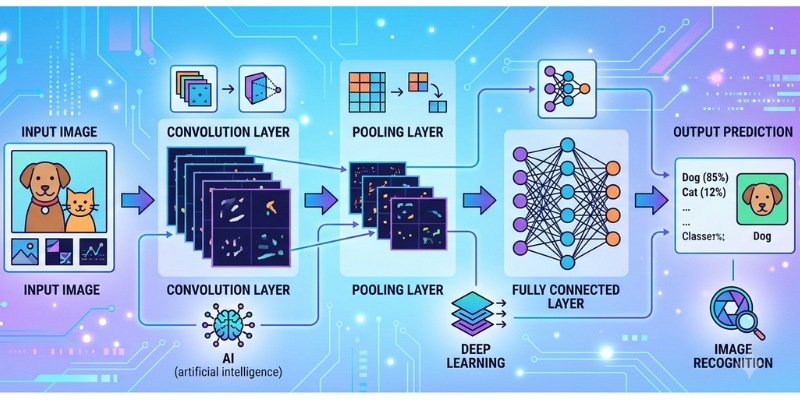
Convolutional Neural Networks, often known as CNNs, are a type of deep learning model specifically designed for processing images and different types of visual data. They help computers recognize patterns, shapes, colors, and objects with impressive accuracy. CNNs have become one of the most important technologies in artificial intelligence because they make it possible for machines to understand visual information in a way that is closer to human perception.
Unlike traditional image processing methods, CNNs automatically learn useful features from data during training. This removes the need for manually defining every detail the model should look for. If you want to build a strong understanding of these concepts and practical applications, consider enrolling in the Artificial Intelligence Course in Mumbai at FITA Academy to strengthen your learning journey.
How Convolutional Neural Networks Work
A Convolutional Neural Network processes an image in several stages. Instead of examining the whole image at once, it looks at small sections to identify important patterns. It first detects simple features such as edges and corners. As the information progresses through the deeper layers, the network starts to identify more intricate patterns such as shapes, textures, and full objects.
The learning process improves as the model is trained with more examples. During training, the network adjusts its internal settings to reduce mistakes and improve its predictions. This ability allows CNNs to perform well even when images have different sizes, angles, or lighting conditions.
Key Components of a CNN
A CNN is made up of several layers that work together to analyze images. The convolution layer is responsible for identifying patterns in small areas of an image. It applies filters that help detect useful visual features.
The pooling layer reduces the amount of information while keeping the most important details. This makes the model faster and helps prevent unnecessary complexity. Finally, fully connected layers combine all the learned features to make the final prediction, such as identifying whether an image contains a cat, a car, or another object.
Applications of Convolutional Neural Networks
Convolutional Neural Networks are used in many industries because they can analyze visual information quickly and accurately. In healthcare, they assist doctors by identifying patterns in medical images. In the automotive industry, they help self-driving vehicles detect roads, pedestrians, and traffic signs. Retail companies use CNNs for product recognition and visual search, while security systems rely on them for facial recognition.
These models are also widely used in agriculture, manufacturing, and entertainment. As their capabilities continue to improve, CNNs are becoming an essential part of modern AI solutions. If you are ready to expand your practical knowledge through structured learning, you can explore the AI Course in Kolkata to build valuable skills for future opportunities.
Benefits and Challenges of CNNs
One of the biggest advantages of CNNs is their ability to learn important image features automatically. They usually provide high accuracy for image classification, object detection, and facial recognition tasks. They can also adapt to different types of visual data without requiring extensive manual feature engineering.
However, CNNs also have some challenges. They require large amounts of training data to perform well. Training these models can take significant computing power and time. In addition, understanding why a CNN makes a particular prediction can sometimes be difficult because of the complexity of deep learning models.
Convolutional Neural Networks have transformed the way computers understand images and visual information. Their layered structure allows them to detect simple patterns first and then combine them into meaningful objects. This makes them one of the most effective deep learning models for image-related tasks across many industries.
As artificial intelligence continues to evolve, learning the fundamentals of CNNs will help you understand many advanced AI technologies. If you want to continue developing your expertise with hands-on guidance and industry-focused training, consider joining the AI Courses in Delhi to advance your artificial intelligence knowledge with confidence.
Also check: Activation Functions and Their Importance
 Dutch
 Polish
 English
 Arabic
 French
 Spanish
 Portuguese
 Deutsch
 Turkish
 Italiano
 Russian
 Romaian
 Portuguese (Brazil)
 Greek